
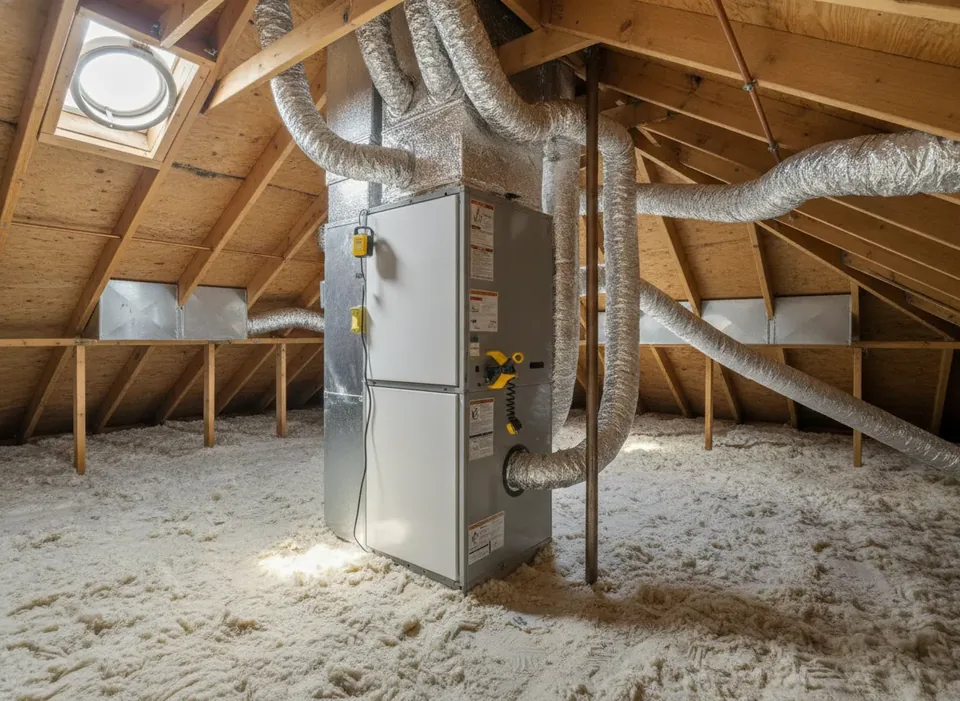
In many San Antonio-area homes, the part of the AC system that does the most work lives in the hottest room of the house. Air handlers and ductwork in the attic are common in San Antonio-area homes, and in summer that attic can be far hotter than the air outside. That matters for your electric bill, for how well the far bedrooms cool, and for what happens when a condensate drain clogs over a finished ceiling.
This guide explains what the research says about attic ducts in hot climates, the warning signs worth acting on, and what repairs typically cost. San Antonio Residential HVAC is a free quote service: we connect San Antonio-area homeowners with independent, TDLR-licensed local HVAC contractors for free, no-obligation quotes. The contractor you choose diagnoses, quotes, pulls the permit and does the work directly with you.
How hot does a San Antonio attic get?
A U.S. Department of Energy Building America case study on a San Antonio builder put it in numbers: the uninsulated, vented attics typical in San Antonio average about 130 °F. The builder's sealed, insulated attics averaged about 80 °F instead, creating an insulated space for the ducts and air handler, and the cooler attic let them downsize the air conditioner by half a ton.
Now add the local weather. NOAA's 1991–2020 normals put the airport's average July high at 94.9 °F and August at 96.0 °F, with about 122 days a year at 90 °F or more. In 2023, the National Weather Service in Austin/San Antonio recorded a record 75 days at 100 °F or hotter, including a record 23 straight triple-digit days, during the hottest summer on record. The city's all-time high is 111 °F (September 5, 2000). Every one of those afternoons, cold air travelling through an attic duct is surrounded by superheated air.
Why attic ducts cost you cooling
DOE's Building America program calls putting HVAC systems in unconditioned attics "highly inefficient." It says the extra heat gain and loss of ducts in vented attics increases heating and cooling energy use by about 10%, and that duct air leakage has been measured to commonly exceed 20% of conditioned airflow.
ENERGY STAR puts it similarly: in a typical house, about 20 to 30 percent of the air moving through the duct system is lost to leaks, holes and poorly connected ducts. In an attic, a leaking supply duct dumps air you paid to cool into a 130-degree space, and a leaking return duct can pull hot, dusty attic air back into the system.
ENERGY STAR's fix is straightforward: seal the duct joints and connections, and insulate ducts in unconditioned spaces like attics with insulation rated R-6 or higher.
Signs your attic ducts need attention
- One or two rooms (often the ones farthest from the air handler) never get as cool as the rest of the house.
- Weak airflow from some vents while the system is running.
- Higher summer bills without a change in how you set the thermostat.
- Extra dust in the house, or dust streaks around supply vents.
- Flex duct you can see lying crushed, kinked, disconnected or with torn insulation when you look into the attic.
- An older home: houses in ZIPs like 78201, 78212 and 78209, or in Alamo Heights (median year built 1950 per the ACS 2024 5-year estimates), may have older ductwork worth inspecting.
If you go into the attic to look, go early in the morning, step only on joists or decking, and do not move or pull on duct connections. A contractor can measure airflow and test for leakage properly.
Drain pans, overflow and water damage
An air conditioner pulls a lot of moisture out of the air in humid summers, and that water has to go somewhere. When the air handler sits above your ceiling, a clogged condensate drain can turn into a stained or sagging ceiling. ENERGY STAR's maintenance checklist says to check the condensate drain, because "a plugged drain can cause water damage in the house and affect indoor humidity levels."
Many attic installations include a secondary drain pan or overflow protection under the unit. Keep it general and simple as a homeowner:
- Know where your condensate line ends outside and glance at it during the summer to see that it drips while the AC runs.
- If you can safely see the pan under the attic unit, water standing in it is a sign the main drain is not draining.
- Water spots on the ceiling below the air handler, or an AC that shuts itself off with a full pan, call for a contractor visit.
Ask the contractor who does your AC maintenance to check the drain line, the pan and any overflow switch on each visit.
Repair, replace or clean?
Not every duct problem calls for new ductwork. Typical published ranges:
| Item | Typical range |
|---|---|
| Duct repair (sections) | $500–$2,600 |
| Ductwork replacement | about $2,000–$3,000 per ton in San Antonio (3 tons: $6,000–$9,000) |
| Air duct cleaning | $300–$700 (about $500 for a 2,000 sq ft home) |
| AC tune-up / maintenance | $150–$350 (CPS Energy offers a no-cost tune-up to eligible customers) |
Repair and seal makes sense when the ducts are basically sound but have leaky joints, a disconnected run or damaged insulation. Replacement is worth quoting when ducts are old, undersized, crushed in many places or poorly insulated, and it is often done at the same time as an AC replacement so the new equipment is not paired with leaky ducts. Cleaning addresses dust and debris, not leaks; our duct cleaning and ductwork repair page explains the difference. Full price details are in the San Antonio HVAC cost guide.
Local rules worth knowing
Duct and equipment replacement is permitted work. In Live Oak, the city's 2026 FAQ says replacing an AC condenser, air handler or ducts needs a permit, with a final inspection and a duct-leakage test when ductwork is replaced. Inside San Antonio, licensed and registered trade contractors pull mechanical permits; elsewhere, check with the city. This is general information, not legal advice.
Attic insulation helps too. CPS Energy lists an attic insulation rebate (for example $0.35 per square foot for contractor-installed insulation, with final R-38 required in qualifying attics). Check CPS Energy for current availability and the full requirements.
Questions to ask a contractor about attic ducts
- Can you measure airflow at the vents, or test the duct system for leakage, before recommending replacement?
- What R-value is the duct insulation you will use? (ENERGY STAR's guide is R-6 or higher in attics.)
- Will you seal the joints and the connection at the air handler, not just tape the outside?
- Is the condensate drain and overflow protection included in the work?
- Is a permit and inspection required, and will you pull it? What is your TDLR license number?
When you are ready, request free quotes and describe what you are seeing; independent local contractors can respond with no obligation.