
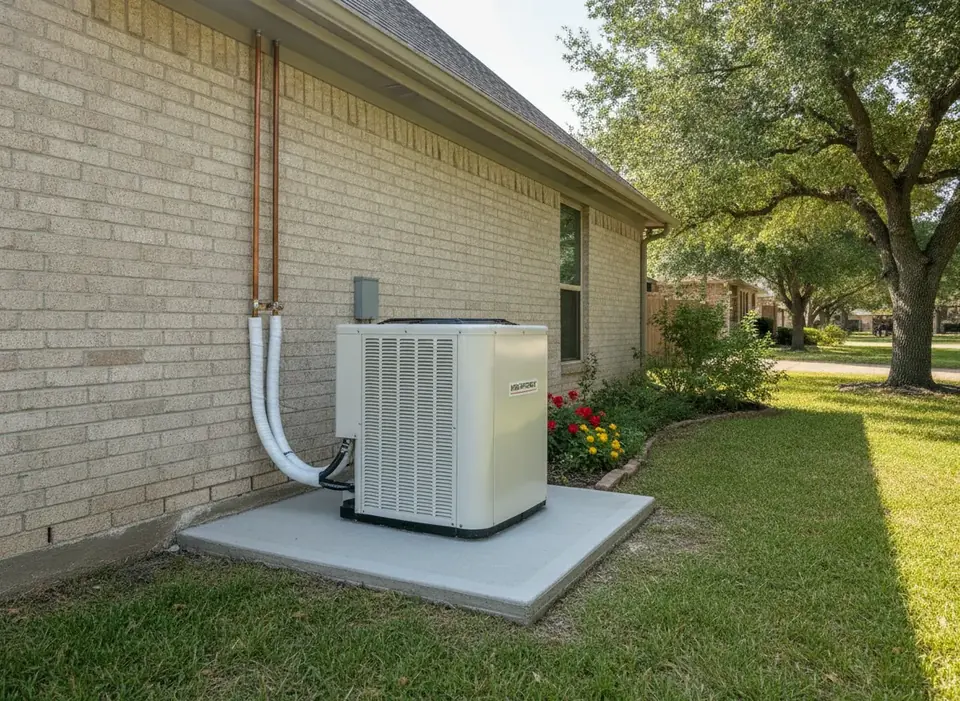
If you are replacing a central air conditioner, heat pump or ductless mini split in San Antonio, CPS Energy may pay part of the bill. The utility's residential HVAC rebates are paid per cooling ton, rise with efficiency, and come with paperwork rules that trip people up: a 30-day deadline, a permit number, an AHRI certificate and model and serial numbers on the invoice. This guide covers the current program year as CPS Energy and its program administrator, CLEAResult, publish it, and what to ask the contractor you hire so the rebate is not lost.
Check availability first. CPS Energy rebates are first-come, first-served and "subject to change or termination without notice." On October 21, 2026, the CPS rebate product page showed "Out Of Stock." Before you count a rebate in your budget, check CPS Energy for current availability.
The 2026–2027 program year
The current residential HVAC rebate cycle covers work completed February 1, 2026 through January 31, 2027. CPS lists three kinds of equipment on the same per-ton schedule: central air conditioners, central heat pumps and ductless mini splits. Window and room AC units are handled separately, at $50 to $75 for qualifying ENERGY STAR units.
The headline figure is $90 to $310 per cooling ton. Where you land in that range depends on two things: the SEER2 rating of the new system and whether CPS treats the job as an early replacement or a replacement on burnout.
Per-ton rebate tiers by SEER2
| SEER2 rating | Early replacement (per cooling ton) | Replace on burnout (per cooling ton) |
|---|---|---|
| 13.8–15.1 | $115 | $90 |
| 15.2–16.1 | $130 | $120 |
| 16.2–17.0 | $175 | $150 |
| 17.1–19.9 | $250 | $225 |
| 20.0 and up | $310 | $275 |
Source: CPS Energy rebate specifications, program year February 1, 2026–January 31, 2027. Amounts are paid only if funding is available.
Example: a 3-ton system rated 16.5 SEER2 falls in the 16.2–17.0 tier. As an early replacement that works out to 3 × $175 = $525; on burnout it is 3 × $150 = $450. Moving up to a 20 SEER2 system would raise those to $930 and $825, though the higher-efficiency equipment usually costs more to buy. Your contractor can price two or three efficiency levels so you can compare the rebate difference against the price difference.
Keep the federal floor in mind, too. In Texas, a new split central AC under 45,000 Btu/h (roughly under 4 tons) must be at least 14.3 SEER2, or 13.8 SEER2 for larger units, and a split heat pump must be at least 14.3 SEER2 and 7.5 HSPF2. So most new home systems start in the first or second tier.
Early replacement vs. replace on burnout
CPS pays more when you replace equipment that still works. To qualify as an early replacement:
- The existing equipment must be operational.
- It must be less than 25 years old for central systems, or less than 20 years old for heat pump systems.
- You need photos plus the model and serial numbers of the old equipment.
If those conditions are not met, CPS says the claim will be processed at the replace-on-burnout rate instead. In practice, if your old unit is still running and you are planning ahead, ask the contractor to photograph the old equipment and its data plate before anything is removed.
Conditions that apply to every rebate
- CPS residential customers only, on retrofit projects. CPS says it "must be a one-for-one replacement" and the rebate "does not qualify for new homes" (a separate new-construction program exists).
- Texas-licensed contractor: all equipment must be installed by an HVAC contractor licensed in the State of Texas. See how to check a Texas HVAC license.
- Permit number: CPS says a "permit number must be provided for all HVAC projects completed within San Antonio city limits." The contractor pulls that city mechanical permit.
- AHRI certificate: efficiency is verified by the AHRI certificate, which must match the model numbers of the new system: condenser, coil and furnace.
- Itemized invoice showing model and serial numbers.
- 30-day deadline: the application and documents must be received within 30 days of installation.
- Cap and timing: the rebate cannot exceed the project cost. CPS lists payment as a bill credit in about 2–3 weeks or a check in about 8–12 weeks.
The permit rule surprises people most. Inside San Antonio city limits, mechanical permits are pulled by licensed, city-registered trade contractors, not homeowners. Our guide to HVAC permits in San Antonio explains how that works and what suburbs such as Live Oak require.
What a rebate does (and doesn't) cover
Published cost guides put a new 3-ton central AC at about $5,000–$12,000 installed nationally, and an AC-plus-furnace replacement in San Antonio at about $9,000–$12,000 at minimum efficiency. A rebate of a few hundred dollars helps, but it rarely decides the project on its own. The bigger levers are correct sizing (ask for a Manual J load calculation), ductwork condition and the efficiency level you choose. Our AC and HVAC cost guide for San Antonio has a calculator that adds a rough CPS rebate line for new AC, heat pump and mini split jobs. These are typical ranges from published cost guides, not quotes.
The no-cost High-Performance A/C Tune-up
Not replacing anything? CPS Energy also offers a High-Performance A/C Tune-up at no cost to eligible customers. According to CPS, it covers airflow measurement, condenser-coil cleaning, the indoor coil and blower, and a refrigerant-charge measurement, and CPS says it can improve cooling output by up to 25 percent. The conditions:
- Residential customer in a single-family home in the CPS Energy service territory.
- An operational central AC or heat pump at least one year old, with no CPS tune-up in the past five years.
- Outdoor temperature of at least 55°F, so late-fall to early-spring slots may be limited.
- The filter must be provided by, or paid for by, the customer.
A paid tune-up from a private company typically runs $150–$350 according to published cost guides, so check CPS first. Read more about AC maintenance and tune-ups in San Antonio.
Questions to ask your contractor about the rebate
- Which SEER2 tier does each option you are quoting fall into, and what would the per-ton rebate be if funding is available?
- Will you photograph the old equipment and record its model and serial numbers for an early-replacement claim?
- Will you pull the city mechanical permit and give me the permit number?
- Will you provide the AHRI certificate and an itemized invoice with model and serial numbers?
- Who files the application, and can it go in well before the 30-day deadline?
Comparing two or three written quotes is the easiest way to see how the efficiency level, rebate tier and price fit together. Learn more about AC replacement, heat pumps and mini split installation in San Antonio.
Get quotes that are rebate-ready
We connect San Antonio-area homeowners with independent, TDLR-licensed local HVAC contractors for free, no-obligation quotes. The contractor you choose diagnoses, quotes, pulls the permit and does the work directly with you, including the paperwork CPS asks for. Rebate amounts and availability are set by CPS Energy, not by us or the contractor. Request your free quote.
Frequently asked questions
How much is the CPS Energy AC rebate in 2026?
For the February 1, 2026 to January 31, 2027 program year, CPS Energy lists $90 to $310 per cooling ton for central AC, heat pumps and ductless mini splits. Early replacements earn $115 to $310 per ton and replace-on-burnout jobs $90 to $275, depending on SEER2. Funding is first-come, first-served, so check CPS Energy for current availability.
How long do I have to apply for a CPS Energy HVAC rebate?
CPS Energy says the application and documents must be received within 30 days of installation. You will need the AHRI certificate, an itemized invoice with model and serial numbers, and, inside San Antonio city limits, the permit number. Ask your contractor who files the application before the work starts so the deadline is not missed.
Does CPS Energy require a permit for an AC rebate?
Yes, for homes inside San Antonio city limits. CPS Energy states that a permit number must be provided for all HVAC projects completed within the city limits. The licensed contractor who installs the system pulls the city mechanical permit and can give you the number for the rebate application. Outside the city, check your own city's permit rules.