
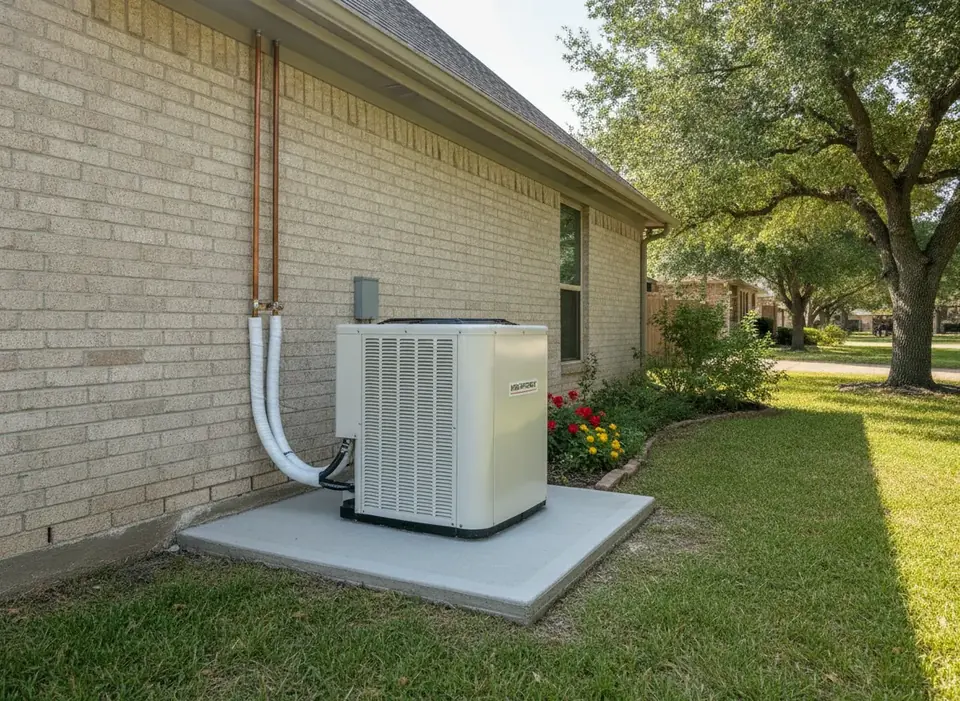
San Antonio is built for heat, not cold. NOAA's 1991–2020 normals for the airport count only about 14 nights a year at or below freezing, and cooling degree days outnumber heating degree days about 2.2 to 1. That is one reason heat pumps make sense here: one outdoor unit cools all summer and heats through a short winter.
But every few years a hard freeze arrives, and that is when heat pumps work hardest and owners start worrying about strange noises, steam and "emergency heat" lights. This guide explains what is normal, what the February 2021 storm showed, and what to look at if you are repairing or replacing a heat pump. San Antonio Residential HVAC is a free quote service: we connect San Antonio-area homeowners with independent, TDLR-licensed local HVAC contractors for free, no-obligation quotes. The contractor you choose diagnoses, quotes, pulls the permit and does the work directly with you.
How a heat pump heats when it is cold outside
A heat pump does not burn fuel. In winter it runs the cooling process in reverse, pulling heat from the outdoor air and moving it inside. There is still usable heat in cold air, but as the temperature drops the heat pump has less to work with, so its heating output falls just as the house needs more.
That is why most ducted heat pumps have backup electric heat in the indoor unit. In general terms:
- Auxiliary heat comes on automatically to help the heat pump when it cannot keep up, or when the house needs to warm up quickly. Seeing "Aux" on the thermostat during a cold snap is usually normal.
- Emergency heat is a setting you choose manually. It runs the backup heat on its own, without the heat pump, and is generally meant for when the outdoor unit is not working. Electric backup heat costs more to run, so it is not meant as an everyday setting; check your thermostat and equipment manual for how your system is set up.
Defrost mode: the noise that worries people
In cold, damp weather, frost forms on the outdoor coil. The heat pump periodically switches into a short defrost cycle to melt it. During defrost the outdoor fan may stop, the unit can make a loud whoosh or clunk, and it can give off a cloud of steam. Then it goes back to heating. That is normal operation.
It also causes a lot of worried calls. During the January 2026 cold snap, News4 San Antonio reported (January 26, 2026) that one local HVAC company owner said most of his calls involved heat pumps struggling to keep up, and that heat pumps "go into defrost mode and make a loud noise. People start to panic and think it's not working." Another local company's service manager told the station they had received "at least hundreds of calls, if not close to 1,000." Weather data for the airport (NOAA's ACIS) shows lows of 22 °F on January 25 and 20 °F on January 26, 2026.
What is not normal: an outdoor unit that stays encased in thick ice for hours, a fan that never restarts after defrost, or a house that keeps losing temperature even with auxiliary heat running. Those are reasons to call a contractor.
What February 2021 showed
The February 2021 winter storm was the real stress test. The National Weather Service's San Antonio records show the airport fell to 9 °F on February 15, 2021, during a run of 9 straight freeze days (February 12–20), tied for the fifth-longest on record. KSAT reported that "more than 300,000 people were without power in Bexar County" during rolling outages.
Two lessons for heat-pump owners came out of it:
- No power means no heat. A heat pump and its electric backup both need electricity. Homes that lost power lost their heat pump and backup heat along with it.
- Extreme cold strains equipment that rarely sees it. A San Antonio HVAC contractor told the trade publication ACHR News in March 2021: "Normally, we have few failures in our area ... This was a nightmare." No official count of local heat-pump failures exists, so treat any specific failure numbers you see with caution.
Before the next hard freeze
- Get a fall check-up. ENERGY STAR recommends a professional check of the heating system every fall; for a heat pump, that includes the defrost controls and backup heat. Our maintenance and tune-up page covers what to ask for.
- Change the filter. ENERGY STAR says to check it monthly. Restricted airflow makes a heat pump work harder in both seasons.
- Keep the outdoor unit clear. Leaves, mulch, snow or ice packed against the coil block airflow. Do not chip ice off the coil; let defrost do its job and call if it does not clear.
- Know your thermostat. Learn what "Aux" and "Em Heat" look like on your model before you need them.
- If you have gas appliances or a dual-fuel system (a heat pump with a gas furnace as backup), make sure working CO alarms are on every level outside sleeping areas, as CPSC recommends. If a CO alarm sounds, leave the house and call 911.
Repairing or replacing a heat pump
ENERGY STAR suggests considering a replacement when a heat pump is more than 10 years old. If you are replacing, these rules and numbers apply in Texas:
- Efficiency: a new split heat pump must be at least 14.3 SEER2 for cooling and 7.5 HSPF2 for heating. HSPF2 is the heating rating; a higher number means more efficient heating.
- Refrigerant: since January 1, 2025, new residential split heat-pump systems must use a refrigerant with a global warming potential under 700 (R-454B or R-32). Existing R-410A heat pumps can still be repaired, and EPA's May 21, 2026 rule lets systems whose components were all made before 2025 be installed until that stock runs out. This is general information, not legal advice.
- Sizing: ask for a Manual J load calculation. A heat pump sized for San Antonio summers still has to heat the house on the coldest nights, with backup heat filling the gap.
| Item | Typical range |
|---|---|
| Heat pump, installed | $5,000–$15,000 (San Antonio 3-ton with air handler: $9,000–$12,000) |
| New central AC, installed (3 tons) | $5,000–$12,000 |
| Service call / diagnostic | $75–$200 (San Antonio guides: about $75–$150) |
| After-hours / weekend | often 2–3× the normal rate, about $150–$300 per hour |
More figures are in the San Antonio HVAC cost guide, and the repair or replace guide walks through the decision.
CPS Energy heat pump rebates
CPS Energy's residential program (February 1, 2026–January 31, 2027) lists heat pump rebates of $90–$310 per cooling ton by SEER2 tier: $115–$310 for early replacement and $90–$275 when replacing a failed unit. For the early-replacement rate, the existing heat pump must still work and be under 20 years old. A Texas-licensed contractor must do the installation, inside San Antonio city limits the permit number is required, and the application is due within 30 days. The rebate page showed "Out Of Stock" on October 21, 2026, so check CPS Energy for current availability before counting on it.
Getting help
If your heat pump is struggling, short-cycling, iced over or blowing cool air on a cold day, a contractor can check the defrost controls, backup heat and refrigerant charge. Our heat pump repair and installation page and heating repair page cover what to expect, and homeowners in newer suburbs such as Cibolo can use the same steps. Before hiring, check the company's TDLR license at TDLR's license search, ask whether the diagnostic fee is credited to the repair, and request free quotes to compare.