
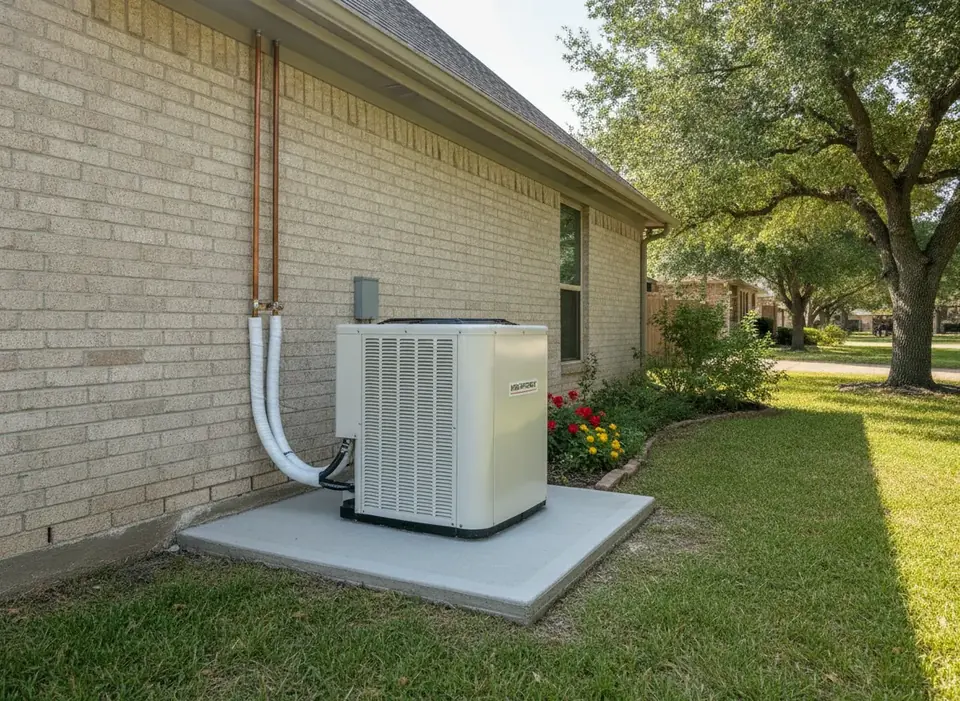
When an air conditioner quits in San Antonio, it rarely picks a cool week to do it. NOAA's 1991–2020 normals for San Antonio International Airport show about 122 days a year at 90 °F or hotter and about 18 at 100 °F or more, and 2023 set the record with 75 triple-digit days. A system that runs that hard eventually leaves you with the big question: pay for one more repair, or put the money toward a new system?
There is no single right answer, but there are a few rules of thumb from ENERGY STAR, some typical price ranges, and several Texas-specific rules (refrigerant, efficiency minimums and CPS Energy rebates) that make the decision much clearer. San Antonio Residential HVAC is a free quote service: we connect San Antonio-area homeowners with independent, TDLR-licensed local HVAC contractors for free, no-obligation quotes. The contractor you choose diagnoses, quotes, pulls the permit and does the work directly with you.
Start with age: the ENERGY STAR rule of thumb
ENERGY STAR's "Repair or Replace?" guidance draws the line at age. If your air conditioner or heat pump is more than 10 years old, it suggests considering a replacement with an ENERGY STAR unit, which "installed correctly" can save up to 20 percent on heating and cooling costs. For a furnace, the line is 15 years. Under those ages, repair is usually the first thing to look at.
Age is a starting point, not a verdict. A 12-year-old system that needs a $150 capacitor is still a repair job for most people. A 6-year-old system with a failed compressor and no warranty coverage is a harder call. Look at three things together: the system's age, the cost of this repair, and how often you have been paying for repairs lately.
What repairs and replacements typically cost
These figures come from published cost guides, not from any contractor's price list. Your own quote depends on the equipment, access (attic installs take longer), ductwork and timing. The San Antonio HVAC cost guide has the full table and a rough calculator.
| Item | Typical range |
|---|---|
| Service call / diagnostic | $75–$200 (San Antonio guides: about $75–$150) |
| Typical AC repair | $250–$700 (average about $375) |
| Capacitor or contactor replacement | $100–$450 |
| Refrigerant recharge (after a leak is fixed) | $150–$900; leak repair plus recharge $200–$1,500 |
| Compressor replacement | $600–$4,000 |
| New central AC, installed (3 tons) | $5,000–$12,000 |
| AC + furnace replacement, San Antonio (3 tons, minimum efficiency) | $9,000–$12,000 |
| Heat pump, installed | $5,000–$15,000 (San Antonio 3-ton with air handler: $9,000–$12,000) |
A quick way to use the table: compare the repair quote with the cost of a new system. A few hundred dollars for a capacitor, contactor or fan motor on a reasonably young unit is usually an easy repair. When a repair runs into the thousands on a system past the 10-year mark, it is worth getting a replacement quote alongside it before you decide.
Compressor failure: the usual tipping point
The compressor is the heart of the outdoor unit, and it is the repair that most often turns a repair conversation into a replacement conversation. Published guides put a compressor replacement anywhere from about $600 to $4,000, depending on the unit size, the part and whether it is still under the manufacturer's warranty. On an older system, that money goes into a unit whose coil, fan motor and other parts are just as old.
If a contractor tells you the compressor has failed, ask them to put it in writing: what failed, how they tested it, whether the part is under warranty, and what labor costs. Then ask for a quote on replacing the outdoor unit or the whole system so you can compare them side by side. Getting a second opinion from another company is reasonable for a repair this size.
Repairing an R-410A system is still allowed
Many San Antonio homes run on R-410A refrigerant. Under EPA's HFC rules, new residential split AC and heat-pump systems must use refrigerant with a global warming potential under 700 (in practice R-454B or R-32) since January 1, 2025; R-410A's is 2,088. EPA's May 21, 2026 rule lets systems whose components were all made or imported before 2025 still be installed until that stock runs out.
None of that forces you to replace a working R-410A system. EPA says plainly that you can keep repairing it, including replacing a major component like a condensing unit or compressor with a similar R-410A part. EPA also notes that availability of these refrigerants and parts may lessen over time as HFCs are phased down, which is one more factor for an older system. One firm rule: never "top off" a system with a different refrigerant. Our R-410A vs R-454B guide covers the change in more detail. This is general information, not legal advice.
If you replace: SEER2 minimums in Texas
Texas sits in the Department of Energy's Southeast region. A new split central AC under 45,000 Btu/h (roughly under 4 tons) must be at least 14.3 SEER2, and 13.8 SEER2 for larger units. A new split heat pump must be at least 14.3 SEER2 and 7.5 HSPF2. Higher-SEER2 equipment costs more up front; whether it pays back depends on how long you keep it and how hard it runs. In a city where cooling degree days outnumber heating degree days about 2.2 to 1, efficiency on the cooling side matters.
If you are weighing a heat pump against a new AC and furnace, our heat pump page and the heat pumps in a Texas freeze article explain the trade-offs.
CPS Energy rebates change the math (if funds are available)
CPS Energy's residential program (February 1, 2026–January 31, 2027) lists rebates for central AC, heat pumps and ductless mini splits of $90–$310 per cooling ton, depending on the SEER2 tier and whether it is an early replacement or a replace-on-burnout job:
- Early replacement ($115–$310 per ton): the old equipment must still work and be under 25 years old for central systems (under 20 for heat pumps), with photos and model and serial numbers.
- Replace on burnout ($90–$275 per ton): the old system has already failed.
Using the CPS table, a 3-ton system rated 16.5 SEER2 works out to $525 as an early replacement or $450 on burnout. The work must be done by a Texas-licensed contractor, with an AHRI certificate and an itemized invoice, and inside San Antonio city limits the permit number is required. The application is due within 30 days of the work. The rebate page showed "Out Of Stock" on October 21, 2026, so check CPS Energy for current availability before counting on it. More detail is in our CPS Energy AC rebates post.
The early-replacement tier is also a reason not to wait for a total failure: if your system is old, still running, and already needing frequent repairs, replacing it before it dies can qualify for the higher rate.
A simple way to decide
- Under 10 years old and a modest repair: repair it, and keep up with maintenance. An AC tune-up in spring catches small problems early.
- Over 10 years old and a small repair: repair is usually reasonable, but start budgeting for a replacement.
- Over 10 years old with a compressor, coil or major refrigerant leak: get a repair quote and a replacement quote and compare them.
- Several repairs in the last couple of years, rooms that never cool: a replacement with a proper load calculation may fix problems a repair cannot.
Before you sign a replacement quote
- Get the company's TDLR license number (it looks like TACLA… or TACLB…) and look it up at TDLR's license search.
- Ask for a load calculation (Manual J) instead of a size based on the old unit.
- Get a written, itemized quote with model numbers, the SEER2 rating and the refrigerant type.
- Confirm the contractor will pull the city mechanical permit; in San Antonio, the CPS rebate needs that permit number.
- Get 2–3 quotes. Our guide to comparing HVAC companies in San Antonio walks through what to ask.
The same steps apply in the suburbs, though permit offices differ; homeowners in New Braunfels, for example, deal with that city's own contractor registration. When you are ready, you can request free quotes for a repair, an AC replacement, or both, and compare them before deciding.